
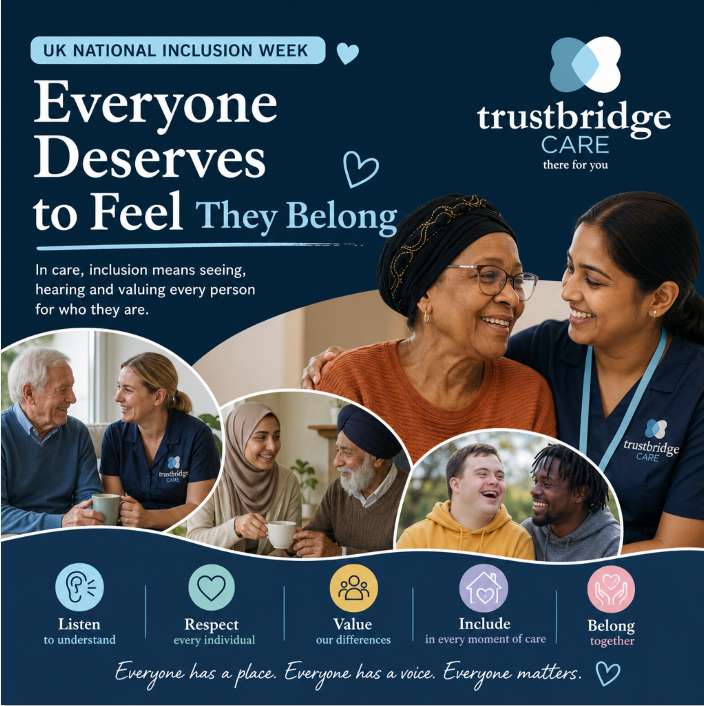
Inclusion can sometimes sound like a big word. But in care, it often comes down to something very simple: making sure people feel seen, heard, respected and valued for who they are.
UK National Inclusion Week is an opportunity to reflect on what inclusion means in our everyday lives and, importantly, what it means for the people we support, their families and our care teams.
At TrustBridge Care, we believe good care starts with understanding the person behind the care plan.
Inclusion starts with listening.
Everyone has their own story, routines, preferences, beliefs, culture and experiences.
For someone receiving care at home, inclusion might mean being supported to continue a familiar routine, preparing food they enjoy, respecting their cultural or religious practices, communicating in a way that works for them, or simply having their choices listened to.
It can also mean recognising that what matters to one person may be completely different from what matters to another.
Person-centred care means making space for those differences.
Skills for Care highlights that people should have equal opportunities to access high-quality care and that workers should have the confidence to understand individual differences and adapt their support accordingly.
Inclusion is also about our care teams
Our care workforce is made up of people with different backgrounds, cultures, experiences, languages, ages and perspectives.
That diversity is part of what makes social care what it is today.
But having a diverse workforce and creating an inclusive workplace are not quite the same thing. Inclusion means creating an environment where people feel comfortable being themselves, where different perspectives can be heard, and where colleagues are treated with fairness and respect.
This is particularly relevant to social care. Current Skills for Care reporting continues to highlight inequalities within the social-care workforce and the importance of creating fairer and more inclusive working environments.
Small things can make a big difference
Inclusion doesn’t always require a big campaign or a major change.
- Sometimes, it is:
- Taking the time to listen.
- Asking someone what matters to them.
- Respecting someone’s choices.
- Learning about different cultures and traditions.
- Making communication easier and more accessible.
- Being mindful that everyone has different needs.
- Checking that people feel comfortable speaking up.
- Making sure colleagues feel welcomed and supported.
- Challenging disrespectful behaviour when we see it.
These everyday actions can help create a culture where people feel that they belong.
Inclusion in someone’s own home
Domiciliary care is unique because we support people in their own homes and communities.
Home is personal. It is where people should feel comfortable, safe and in control.
That is why understanding the individual is so important.
A person’s background, relationships, routines, interests and preferences should not be treated as an afterthought. They are part of who that person is.
Building a culture where everyone belongs
National Inclusion Week gives us a chance to pause and ask ourselves a simple question:
“What can I do today to help someone else feel included?”
It could be a colleague who needs to feel heard, a client who wants their choices respected, a family member who needs reassurance, or someone who simply wants to be treated with kindness and dignity.
At TrustBridge Care, we believe inclusion is not something that should only be recognised during one week of the year.
It should be part of how we care, communicate, work and support one another every day.
Because everyone deserves to feel that they belong.
This National Inclusion Week, let’s continue to listen, learn, respect differences and make space for everyone.
Everyone has a place. Everyone has a voice. Everyone matters.