


This October, in recognition of Breast Cancer Awareness Month, TrustBridge Care is proud to join the global effort to raise awareness, share knowledge and support those affected by breast cancer. By understanding the signs, risks, and ways to care for those on their journey, we can all play a part in promoting early detection, improving outcomes and showing compassion to those who need it most.
What is breast cancer?
Breast cancer is a disease in which cells in the breast grow out of control. These cells can form a tumour (sometimes felt as a lump), invade surrounding tissues, or spread (metastasise) to other parts of the body.
In the UK, organisations like Breast Cancer Now provide trusted information and support to people affected by breast cancer.
Because early detection and prompt treatment improve outcomes, awareness—especially during October—is so important.
What are the main types of breast cancer?
Breast cancer is not just one disease; there are several subtypes, each with its own behaviour, prognosis and treatment options. Some of the main types include:
| Type | Description / Key features |
| Ductal carcinoma in situ (DCIS) | A non-invasive cancer where abnormal cells are found in the lining of a breast duct but have not spread beyond it |
| Invasive (or infiltrating) ductal carcinoma (IDC) | The most common type: cancer that began in a duct and then invades surrounding breast tissue |
| Invasive lobular carcinoma (ILC) | Cancer that starts in the lobules (milk-producing glands) and then spreads beyond them |
| Triple-negative breast cancer (TNBC) | A subtype lacking estrogen, progesterone and HER2 receptors; tends to be more aggressive and with fewer targeted treatment options |
| HER2-positive breast cancer | Cancer with overexpression of the HER2 protein; often responsive to HER2-targeted therapies |
| Hormone receptor–positive (ER/PR-positive) | Cancer cells that grow in response to estrogen or progesterone; often responsive to hormone-blocking therapy |
| Inflammatory breast cancer | A rarer, aggressive form where the breast looks red, swollen and feels warm — often without a distinct lump |
These subtypes matter because they guide the treatment plan: surgery, chemotherapy, hormone therapy, targeted treatment, radiation or combinations thereof.
Is breast cancer hereditary?
Breast cancer can have a hereditary component, though most cases are not directly inherited.
- In Britain, it’s estimated that about 3–10 % of breast cancers are due to inherited gene changes.
- Some of the best-known genes are BRCA1 and BRCA2. If someone inherits a harmful variant (mutation) in one of these, their lifetime risk of developing breast cancer is significantly increased compared to the general population.
- However, inheriting a mutation is a risk factor, not a guarantee: not everyone with such a mutation develops cancer.
- Other genes besides BRCA (e.g. PALB2, CHEK2, TP53) also contribute in some cases.
- If there is a strong family history (e.g. close relatives with breast, ovarian, or related cancers, especially at younger ages), genetic counselling/testing may be recommended. f
So yes — heredity plays a role in a minority of cases — but in most instances, breast cancer arises from a complex mix of genetic, hormonal and environmental factors.
What are the symptoms and how to check yourself
Common symptoms of breast cancer
Early breast cancer often causes no symptoms. As it progresses, some warning signs may include:
- A new lump or thickening in or near the breast or underarm area
- Change in breast size, shape, or contour
- Dimpling, puckering, or “skin of an orange” texture (peau d’orange)
- Inversion or retraction of the nipple
- Nipple discharge (which may be clear, bloody, or unusual)
- Redness, scaling, or ulceration of the breast skin or nipple area
- Breast or nipple pain (less common as an isolated symptom)
- Swelling, warmth, or heaviness in the breast (especially in inflammatory breast cancer)
Because many of these signs may be subtle or overlap with benign breast conditions, the principle “if in doubt, check it out” applies.
How to check yourself — “Know Your Normal”
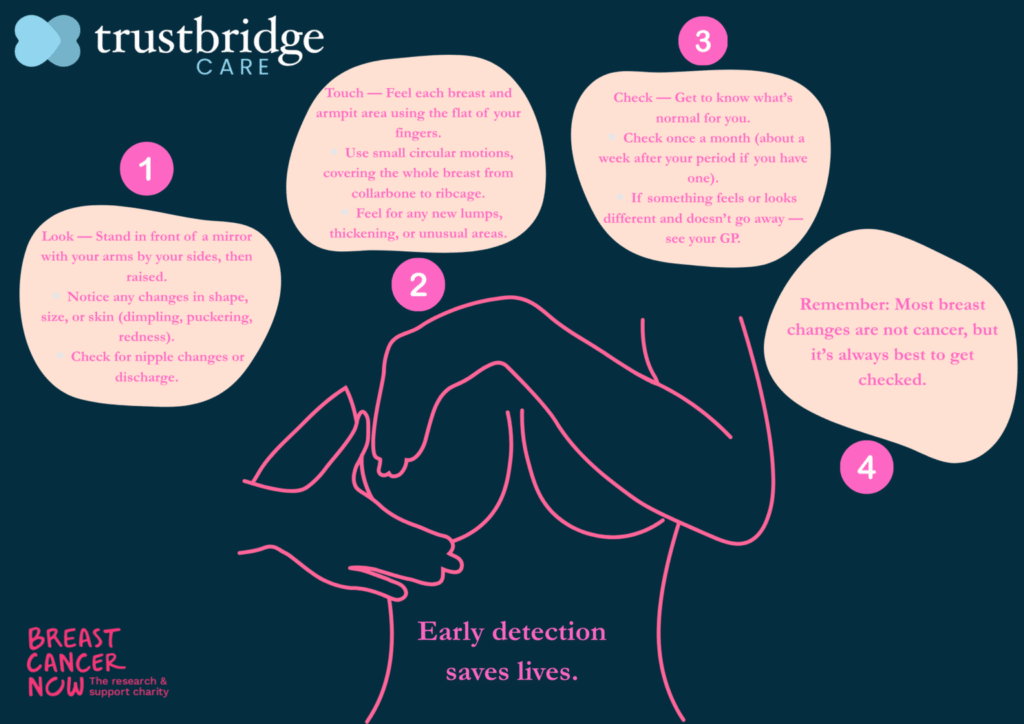
Self-examination is not a substitute for mammograms or clinical screening, but it helps you become familiar with how your breasts normally feel and spot changes early. Here’s a simple approach:
- Look in the mirror
- With shoulders straight and arms by your sides, examine your breasts for changes in shape, size, or skin (dimpling, puckering).
- Raise your arms and look for the same changes.
- Look for any nipple inversion or discharge.
- Feel your breasts while lying down
- Use your opposite hand to feel the breast, using a circular motion from the outer area to the nipple.
- Vary pressure (“light, medium, firm”) to feel all layers.
- Cover all areas: the breast, under the armpit, upper chest.
- Feel while standing or in the shower
- Many people find this easier when their skin is wet and slippery.
- Again, use the same pattern and cover the entire breast and adjacent area.
- Be consistent
- Do the checks at roughly the same time each month (for those who still menstruate, many choose ~1 week after period).
- The goal is not perfection but noticing changes (a lump, a hard area, something new).
If you see or feel a change that’s new, unusual, persistent (e.g. over 2–3 weeks), or concerning, consult your GP or specialist. Early detection matters.
Organisations like Breast Cancer Now emphasise “Touch, Look, Check” as part of awareness.
How TrustBridge Care can support someone navigating a breast cancer journey
At TrustBridge Care, our aim is to provide compassionate, tailored support for clients — including those who are currently managing or recovering from a breast cancer diagnosis. Here’s how we can help:
- Personalised care planning
- We work with the individual, their medical team and family to design a care plan that adapts to evolving needs (post-surgery recovery, fatigue, mobility, etc.).
- Flexibility is key: as treatment phases shift (e.g. during chemotherapy, radiation, or post-operative phases), so do care needs.
- Physical support & assistance with daily living
- Help with mobility, transfers, bathing, dressing, gentle exercise encouragement.
- Nutritional support: ensuring adequate nutrition and hydration, arranging for meals and liaising with dietitians as needed.
- Wound care support in liaison with nursing teams (for surgical sites, drains, mastectomy dressings) — though clinical procedures remain with nursing staff, TrustBridge can assist with monitoring, supporting and ensuring safety.
- Emotional & psychological support
- Providing companionship, a listening ear, reassurance and encouragement through periods of stress or uncertainty.
- Helping to reduce social isolation — accompanying to appointments, facilitating phone / video calls with loved ones, or being a consistent support presence.
- Linking with counselling, peer groups, or support charities (e.g. Breast Cancer Now) for specialist emotional care.
- Coordination & advocacy
- Assisting with liaising between hospital, community nursing, physiotherapists, social services and family.
- Reminding clients of appointments, medications, or care instructions.
- Helping to navigate non-medical practicalities: transport, benefits, home adaptations, rest, gentle rehabilitation.
- Continuing care & follow-up
- After major treatment, many clients benefit from rehabilitation support (gentle mobilising, lymphoedema management advice, scar care, maintaining activity).
- We can monitor for changes, encourage adherence to follow-up plans and support quality-of-life measures (e.g. pacing, energy conservation, gentle physical activity).
- If a client’s needs change (e.g. secondary breast cancer or metastasis), we can adapt care accordingly in close consultation with medical teams.
By providing a stable, compassionate presence and a “bridge” between medical interventions and daily life, TrustBridge can help people feel safer, more supported and less alone on their cancer journey.

Closing thoughts
Breast Cancer Awareness Month is a vital reminder of the ongoing need for education, self-awareness, early detection and compassionate care. While breast cancer remains a serious disease, advances in diagnosis, treatment, and support mean many people survive and live well after a diagnosis. Organisations like Breast Cancer Now play an essential role in campaigning for better services, funding research, and offering support.
At TrustBridge Care, we are committed to being part of that support network — walking alongside clients with dignity, empathy, and tailored care. If you or a loved one is facing breast cancer, remember:
- Know your body — get familiar with what’s “normal” for you.
- Don’t delay seeking help for any persistent, unusual change.
- You don’t have to go through this alone — reach out, lean on your care team, and seek emotional/peer support.
- And for those of us in care roles: we can and should do better to ask, listen, adapt and support with compassion at every step.